The headline from Giving USA 2026: The Annual Report on Philanthropy for the Year 2025 is genuinely worth celebrating. Americans gave an estimated $617.20 billion to charitable causes in 2025, the first time the sector has crossed the $600 billion threshold.
For those of us who work in healthcare philanthropy, however, looking past the headline is not just advisable. It is urgent.
Giving to health grew 6.1 percent in 2025, reaching $61.43 billion. Adjusted for inflation, the real growth rate was 3.3 percent. On its surface, that sounds like solid performance. Context is everything.
When the Tide Rises, Every Boat Should Rise With It
Consider where health sits relative to the broader philanthropic landscape in 2025:
- Education grew 11.7% in current dollars (8.9% inflation-adjusted)
- Public-society benefit grew 11.6% (8.7% inflation-adjusted)
- Environment and animals grew 11.0% (8.2% inflation-adjusted)
- Arts, culture, and humanities grew 7.5% (4.7% inflation-adjusted)
- Health grew 6.1% (3.3% inflation-adjusted)
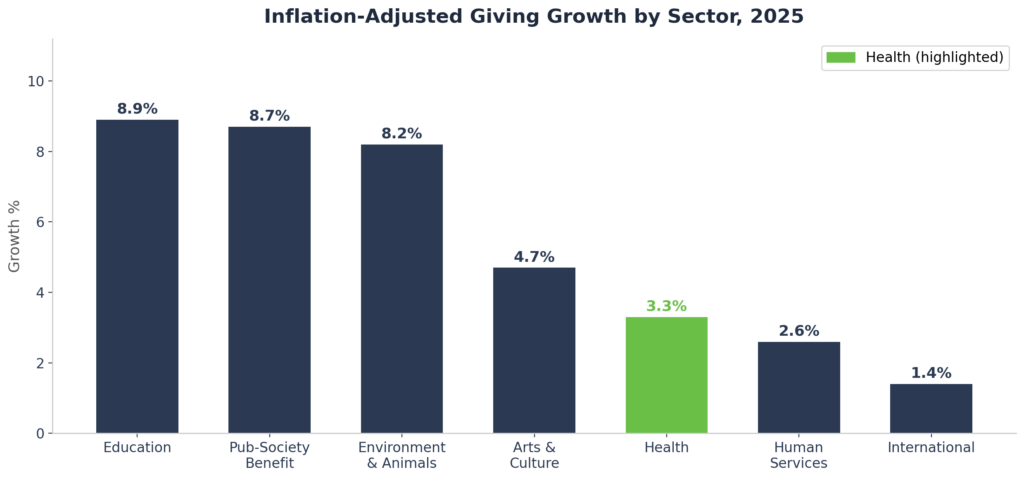
Figure 1: Inflation-adjusted giving growth by sector, 2025. Health (green) trails every major sector. Source: Giving USA 2026
Health lags every major growth sector. The two-year cumulative picture from 2023 to 2025 makes the trend impossible to dismiss. While education grew 16.9 percent over that period and environment grew 21.8 percent, health grew just 6.0 percent in current dollars.
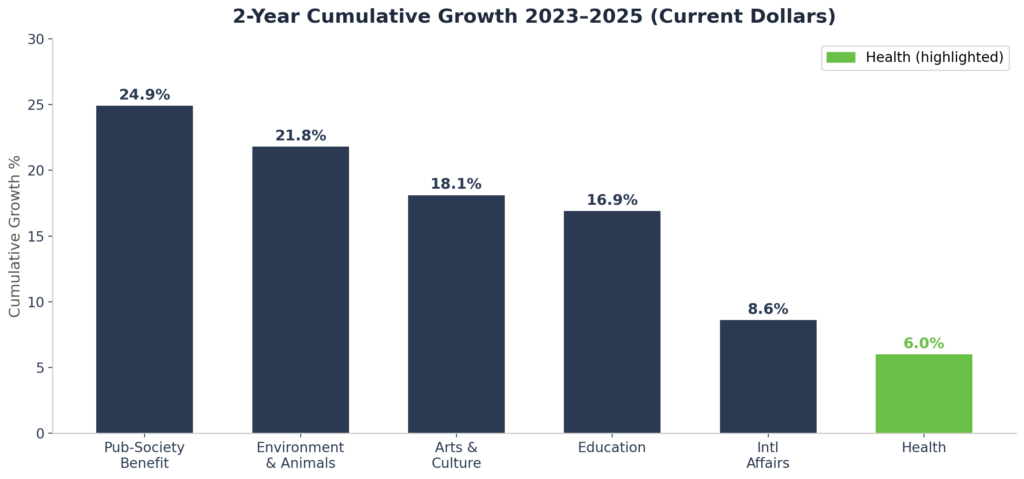
Figure 2: Two-year cumulative growth 2023–2025 (current dollars). Health is the slowest-growing major sector. Source: Giving USA 2026
Adjusted for inflation over those two years, health grew just 0.3 percent — essentially flat.
The report also confirms that giving to health has comprised between 7 and 9 percent of total giving for the past four decades.
Health’s market share has not grown in 40 years. That is not a badge of stability. That is evidence of stagnation in the face of massive systemic need and arguably the most emotionally compelling case for giving in all of philanthropy.
| “Health’s market share of total giving has not grown in 40 years. That is not stability. That is stagnation.” |
The Generation Healthcare Philanthropy Is Ignoring
There is a dimension of the data that deserves far more attention: the dramatic rise of Millennial and Gen Z donors across the philanthropic sector, and the near-total absence of a strategy to engage them in healthcare.
Millennial giving increased 22 percent between 2021 and 2024, reaching an average of $1,616 per donor annually, surpassing Gen X.
A 2026 Bloomerang study found that 75 percent of Millennials plan to give more this year than last, compared with 49 percent of Gen X and 36 percent of Baby Boomers. Eight in ten Millennials plan to give to at least one new nonprofit in 2026, more than twice the rate of Boomers.
Gen Z giving grew 16 percent over the same period, and as 41 million Gen Zers turned 18 in 2024 alone, that trajectory will only accelerate.

Figure 3: Average annual giving per donor by generation (2024), with growth rates since 2021. Source: Giving USA Foundation / Dunham + Company
This is not a future consideration. The wealth transfer is already underway. An estimated $84 trillion will move from Baby Boomers to younger generations through 2045.
This cohort gives differently: to causes, not institutions; through digital channels, peer networks, and recurring giving models; and increasingly through donor-advised funds. Forty-two percent of Millennials are already using DAFs or other tax-advantaged vehicles, vastly outpacing older generations.
Other sectors are paying attention. Higher education has invested in young alumni engagement infrastructure for decades. Environmental organizations and arts institutions are adapting their messaging, channels, and engagement models to meet younger donors where they are.
Healthcare philanthropy, by and large, is not.
The reason is familiar: healthcare development programs are structured around the known high-net-worth prospect. The grateful patient with the large estate. That focus is rational in isolation, but it creates a structural blind spot. Younger patients, family members, and community supporters who have been touched by care are not being cultivated, not receiving meaningful stewardship. When they arrive at their peak earning and giving years, they will not have a relationship with a healthcare institution ready to receive them.
The irony is that healthcare has a built-in emotional connection that most sectors would pay anything to manufacture. Care that saves lives. Research that changes outcomes. These are precisely the cause-driven, impact-oriented narratives that motivate Millennial and Gen Z donors. But only if the relationship has been built.
| “Healthcare has the emotional connection younger donors are looking for. The question is whether the infrastructure exists to meet them.” |
What Is Actually Holding Health Philanthropy Back
At GOBEL, we work with health systems and hospital foundations across the country, and we see the same patterns repeatedly.
Underinvestment in the full donor pipeline.
Healthcare philanthropy remains disproportionately focused on the top of the pyramid. Education’s dramatic gains are not coincidental. Colleges and universities have invested heavily in annual giving programs and pipeline development at every level for decades. Healthcare has not made comparable investments in the full funnel and as such do not have the technology, resources or capability to reach donors where they are and in the manner most likely to engage them. The grateful patient represents arguably the most powerful philanthropic pipeline in all of fundraising, yet most health systems are barely activating it.
Data and intelligence gaps.
You cannot prospect for what you cannot see. Many healthcare philanthropy programs lack the tools to systematically identify high-potential donors across the full patient population, connect clinical data with philanthropic indicators, and act on that intelligence at scale. In addition, many institutions area also missing an opportunity to leverage larger scale market trends, such as percentage of disposable income across donor populations to inform smarter strategies for engagement and better models for forecasting capacity and potential. The result is a reactive, referral-dependent model that will always underperform.
Innovation lag.
AI-driven prospect identification, sophisticated grateful patient programs, and integrated digital engagement strategies remain the exception rather than the rule in healthcare development shops. Meanwhile, 97 percent of nonprofit leaders across all sectors report actively adjusting their fundraising strategies to reflect younger donor preferences — a conversation most healthcare philanthropy programs have not yet had.
What the Report Is Really Telling Us
The appetite for health giving is real. Affluent donors consistently rank healthcare as a top philanthropic priority.
But assets are not outcomes. The philanthropic sector is competitive and increasingly concentrated among organizations that have built the infrastructure to find, engage, and retain donors at every level and across every generation. While health philanthropy celebrates a record-high $61.43 billion, education, environment, and public-society benefit are accelerating. The next generation of donors is stepping into their philanthropic prime, and most healthcare organizations have no plan to meet them.
A 3.3 percent inflation-adjusted gain in a year when the philanthropic tide was rising broadly is not a reason to celebrate. It is a call to examine our assumptions, increase our investment, and build the infrastructure that the mission of healthcare philanthropy demands.
The patients are there. The potential is there. The question is whether healthcare philanthropy will build the programs, deploy the data, and make the institutional investment required to realize it.
| “A 3.3% real gain while the tide was rising is not momentum. It is a signal that something structural needs to change.” |
Sources & Citations
- Giving USA Foundation. Giving USA 2026: The Annual Report on Philanthropy for the Year 2025. Indiana University Lilly Family School of Philanthropy, 2026. https://givingusa.org
- Bloomerang / The Harris Poll. The Bloomerang 2026 Giving Signals Report. May 2026. https://www.prnewswire.com/news-releases/while-nonprofits-eye-gen-z-millennials-are-shaping-philanthropic-giving-302775590.html
- Giving USA Foundation / Dunham + Company. Giving by Generation. Special Report, 2024–2025. https://candid.org/blogs/what-motivates-donors-charitable-giving-across-generations-trends
| About GOBEL
GOBEL is a healthcare philanthropy consulting, analytics, and software company dedicated to helping health systems and hospital foundations build high-performing development programs. Learn more at GOBELgroup.com |